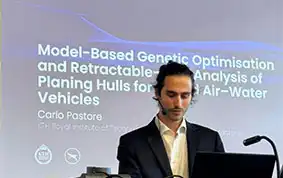
During the Marine Technology Days held last week at KTH Royal Institute of Technology, Carlo Pastore, Chairman and Chief Naval Architect at Mantavia AB, presented his work on planing hull design and optimisation for hybrid air–water vehicles. The research forms an integral part of Mantavia’s ongoing development programme, focusing on the interface between naval architecture and aerodynamics within high-speed, low-emission Ground-Effect Vehicles (GEVs). Pastore’s work introduces an advanced analytical framework built upon the Savitsky method, extended to account for aerodynamic lift and drag contributions at high Froude numbers. The model aims to improve performance prediction for next-generation hybrid craft operating in the transition regime between sea-borne planing and wing-in-ground effect flight.
“This research is a key step in bridging traditional naval hydrodynamics with aerospace modelling,” said Carlo Pastore. “Our goal is to develop a hull system that can actively manage aerodynamic interaction and reduce total resistance — essentially hiding the step during flight to achieve greater efficiency.”
In the coming months, Mantavia’s research will advance through wind-tunnel testing and CFD validation, exploring new solutions for hull morphing and energy-efficient lift generation.
This work reinforces Mantavia’s commitment to pushing the boundaries of sustainable marine and coastal mobility through research excellence and close collaboration with KTH Innovation and Swedish academia.